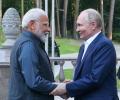
The Indian government is dealing with the matter having in mind the national interests of this country in the first place, he said.
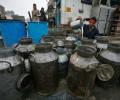
India has fully protected its sensitive sectors like dairy, rice, wheat, pulses, tea, genetically modified (GM) goods, and coffee by not granting any import duty concessions to the European Union (EU) under the bilateral free trade agreement, according to the Commerce Ministry.

Two expatriate workers were killed after debris from a downed drone fell in an industrial area in the Sohar province of Oman.

Equity benchmark indices Sensex and Nifty advanced for the third straight session on Tuesday driven by firm global cues and optimism over India-US trade agreement, even as investors turned to profit-booking at higher levels.

The US Department of the Treasury on Wednesday imposed sanctions on Russia's two largest oil companies, Rosneft and Lukoil, in an effort to pressure the Kremlin to end its war in Ukraine.

The question is no longer whether the war will expand. It has. The next few days will tell us whether the war stabilises around Hormuz or whether the Strait itself becomes the trigger for a far larger rupture. What to watch for over the next 48 hours is simple: Any move by the US toward direct naval control of the Strait; any credible Iranian attempt to disrupt or mine shipping lanes and, critically, whether energy infrastructure in the Gulf continues to be targeted.If those lines are crossed in tandem, the war will no longer be containable within the region.

From the 30-Sensex firms, Larsen & Toubro, Tech Mahindra, Tata Consultancy Services, Reliance Industries, Tata Steel, and Trent were among the biggest laggards. On the other hand, Eternal, ICICI Bank, Bajaj Finance, and Bharat Electronics were the gainers.

In the wake of the FTA between India and the European Union, the United States has described the Europeans as 'very disappointing', saying they were unwilling to join Washington, DC in putting tariffs on New Delhi for its purchases of Russian oil because of this trade deal.

Among Sensex firms, Asian Paints jumped the most by 4.18 per cent. Mahindra & Mahindra, Bharti Airtel, ITC, Hindustan Unilever, ICICI Bank and Reliance Industries were also among the gainers. However, Infosys, HCL Tech, Eternal, Tech Mahindra and Tata Steel were among the laggards.

India said it is broad-basing and diversifying sourcing of petroleum product to meet market conditions.
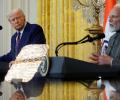
India responds to US President Trump's claim that PM Modi assured him of halting Russian oil imports, stating it is diversifying energy sources to meet market conditions and safeguard consumer interests.

Benchmark indices Sensex and Nifty ended lower on Thursday, snapping a three-day rally, amid a weak trend in global stock markets.
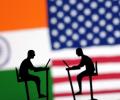
The US said India will lower tariffs on a "vast array" of American industrial and agricultural goods, such as "fruits, vegetables", to zero per cent under the trade deal announced by President Donald Trump.

The verdict marks a notable shift from a series of recent wins for Trump at the Supreme Court.

Dubai's core promise -- that it is an oasis untouched by regional storms -- has been tested in full public view. The coming months will show whether investors view the attacks as a short-lived disruption or a deeper signal of lasting risk, points out Asif Ullah Khan.
Benchmark BSE Sensex fell 558 points on Thursday amid heavy selling in IT shares, as concerns over AI-led disruptions and waning hopes of a Fed rate cut after firm US economic data weighed on investor sentiment.

The rupee appreciated 13 paise to close at 90.34 against the US dollar on Thursday, on trade deal optimism and overnight decline in commodity prices, even as the upside remained capped as investors look for more clarity on the India-US trade deal.

'It is too early to conclude that there will be a bloodbath, that there will be no jobs, and that there will be civil unrest.' 'Let's calm down.' 'AI is a tool, it is not a weapon, it is not a virus.'
US and India will promptly implement this framework and work towards finalising the interim agreement with a view to concluding a mutually beneficial bilateral trade agreement.
From the Sensex pack, Asian Paints, ICICI Bank, PowerGrid, Larsen & Toubro, Bajaj Finserv, Bharti Airtel, Sun Pharmaceuticals, Maruti Suzuki India, Axis Bank, UltraTech Cement and HCL Technologies were the only gainers. On the other hand, Eternal, Tata Motors' commercial vehicles arm, Mahindra & Mahindra, Tata Steel, Bharat Electronics Ltd, Tata Motors Passenger Vehicles, Trent, Tata Consultancy Services, Hindustan Unilever, and Infosys were among the laggards.
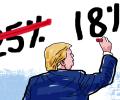
Several farmer organisations in India are protesting the proposed India-US trade deal, expressing concerns about its impact on the agriculture sector and demanding the resignation of the Commerce Minister.

The rupee witnessed a volatile trading session and settled for the day on a slightly lower note, down 1 paisa at 90.66 against the US dollar on Monday, as traders assessed the details of the India-US interim trade framework.

The BSE Sensex and the Nifty 50 declined around 4.5 per cent each since the start of the West Asia conflict.

'Trade deal will act as a strong trigger for market sentiment, not just for domestic investors but also for FIIs.'

Both countries commit to provide each other preferential market access in sectors of respective interest on a sustained basis

Benchmark equity indices Sensex and Nifty extended their gains for the second straight session on Monday, driven by optimism over the India-US trade deal and robust buying in public sector banks, consumer durables, and realty stocks.

In an event-heavy week, stock investors will track ongoing quarterly earnings, the US Federal Reserve's interest rate decision, and macroeconomic data for market direction, analysts said. Moreover, progress in India-US trade negotiations will remain a key focus for investors, an expert said.
The petroleum ministry has projected a strong year for the oil marketing companies though the largest exploration company, Oil and Natural Gas Corporation, is projected to post a moderate gain in its bottomline.

Stock market is gearing up for an eventful week ahead where key triggers such as quarterly earnings from corporates, the US Fed interest rate decision and the upcoming Union Budget for 2026-27 would grab the limelight, analysts said.


From the Sensex firms, Tata Steel tanked the most by 4.57 per cent. ICICI Bank, Power Grid, HCL Tech, Tech Mahindra, Infosys and Kotak Mahindra Bank were also among the laggards. Mahindra & Mahindra, State Bank of India, ITC and Bharat Electronics were among the gainers.

What we are watching is something different: A fog manufactured and maintained by the people who started the war, so that the question of why it was started never has to be answered, observes Prem Panicker in his must read blog on the war in the Middle East.

The ruling is expected to have wide-ranging consequences for global trade, businesses, consumers, inflation trends and household finances across the country.
Market sentiment is likely to remain cautious as investors position themselves for the upcoming Union Budget and the US Fed's interest rate decision, where expectations are muted.

Finance Minister Nirmala Sitharaman's biggest challenge will be to find a new growth driver, particularly against the backdrop of a global economy ravaged by heightened uncertainty and fragmentation, financial markets on a precipice, and global commodity prices on a continued uptrend.
The assurance came after a meeting of the Saudi Arabia's Supreme Council for Petroleum and Mineral Affairs, which was chaired by King Abdullah. The meeting, which reviewed world oil market developments, referred to the resolution taken by the last OPEC summit in Riyadh in which leaders said they would manage petroleum resources to ensure sustained development. The summit expressed its satisfaction over the progress of work at new investment projects.

New Delhi 'will have to take a call which supply source suits us the best,' the finance minister said, pointing out that crude oil accounts for the bulk of India's foreign exchange spend.

India's crude oil imports from Russia saw a marginal decline in September, but continued to account for over one-third of the country's total oil purchases, despite US pressure to curb the trade over concerns that it supports Moscow's war effort in Ukraine. India's crude imports in September were around 4.7 million barrels per day, up 220,000 bpd month-on-month and flat year-on-year.

From the Sensex pack, Sun Pharma, Eternal, Tata Motors, Bajaj Finance, IndusInd Bank and Bajaj Finserv were among the major laggards. In contrast, Tech Mahindra, Infosys, Asian Paints and Maruti were among the gainers.

Prime Minister Narendra Modi inaugurated Micron Technology's semiconductor plant in Sanand, Gujarat, highlighting India's growing presence in the hardware sector and its strong partnership with the United States in AI and chip technologies.
